

Periodontal Treatments
What is periodontal treatment?
Periodontology (gum specialty) is the branch of dentistry that aims to protect the health of the gums, jawbone and supporting tissues surrounding the teeth, and to diagnose and treat the diseases that occur. Given that in many adults the main cause of tooth loss is not decay but problems in the gums and surrounding tissues, gum care and treatment are of great importance. Thanks to these treatments, teeth at risk of being lost are kept in the mouth and both aesthetic and healthy gums are readily achieved.
Who is it suitable for?
- Those who have gum bleeding when brushing or spontaneously,
- Those who observe pain, swelling, sensitivity and unusual redness in the gums,
- Those at risk of gum problems due to inadequate oral hygiene, genetic factors, systemic diseases (diabetes, etc.) or hormonal changes,
- Those with gum irritation from previous incorrect treatments (overhanging fillings, faulty prostheses),
- Patients who encounter gum recession because of malposition of the teeth (crowding), poor diet, stress, dry mouth or a clenching/grinding habit.
How does treatment proceed?
- Examination and diagnosis: Bleeding, swelling, colour change and pocket depths in the gums are measured clinically by a gum specialist (periodontist). Radiographs are used to see whether there is bone loss.
- Scaling (detartrage): Bacterial plaque and tartar adhering to the tooth surface, the main cause of the disease, are cleaned with ultrasonic devices without harming the teeth.
- Root-surface planing (curettage): If infection has gone deep into the gum pocket, inflamed tissues and deposits on the root surface are cleaned thoroughly under local anaesthesia.
- Advanced surgical treatments: In cases of advanced bone loss or gum recession, flap operations, bone graft (powder) applications or surgical procedures aimed at gum aesthetics are performed.
Points to consider before treatment
- Systemic diseases underlying or triggering gum disease (diabetes, etc.), hormonal status and all medicines used must be reported to the dentist in full.
- Smoking is one of the greatest factors masking gum bleeding, allowing the disease to progress silently and causing tissue destruction. Reducing smoking to a minimum or stopping completely is of great importance for treatment success.
Points to consider after treatment
- Personal oral hygiene: The lasting effect of treatment in the clinic depends entirely on the patient’s daily care at home. Teeth should be brushed twice a day with the correct technique, and dental floss and interdental brushes recommended by the dentist used regularly.
- Replacement of faulty restorations: If overhanging fillings that cause gum problems or faulty prostheses that press on the gum are present, they must be renewed after treatment.
- Regular follow-up: Gum diseases tend to recur when care is neglected. Routine dental check-ups every 6 months must therefore not be omitted.
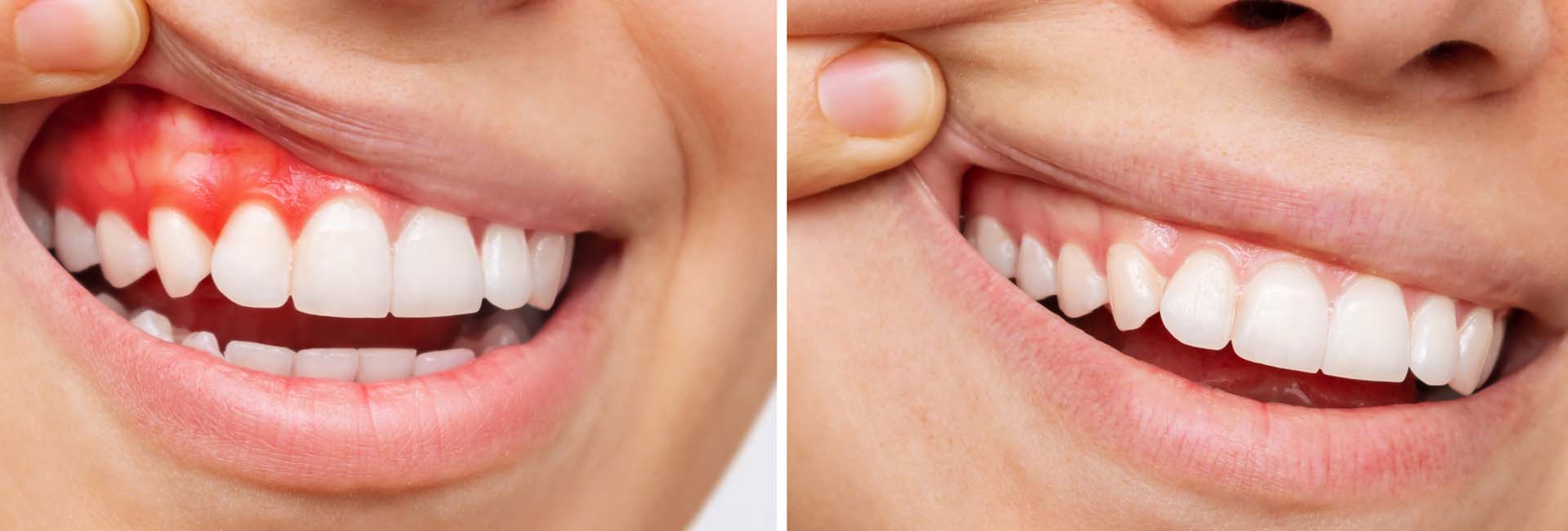
A healthy gum has the following features:
- It is light pink (rose) in colour.
- Its surface is slightly stippled, like orange peel.
- It does not bleed at all during brushing or flossing.
- There is no pain, swelling or redness.
- It is firmly attached to the teeth and the bone beneath.
- At the area where it meets (ends against) the tooth it forms a thin, smooth line like a knife-edge.
The main cause of gum diseases is bacterial plaque and tartar accumulating on the tooth surface. In addition, inadequate oral hygiene, genetic factors, systemic diseases, smoking, hormonal changes, stress, dry mouth, poor diet, faulty fillings/prostheses, clenching (bruxism) and crowding of the teeth play an important role in the onset and rapid progression of these diseases.
No, you should certainly not stop. Gum bleeding is the greatest and earliest sign that there is an infection (inflammation) in the area. Stopping brushing for fear of bleeding causes bacterial plaque to increase further and the disease to progress rapidly towards the bone. If there is bleeding you should see a gum specialist without delay.