

Root canal treatments
What is root canal treatment?
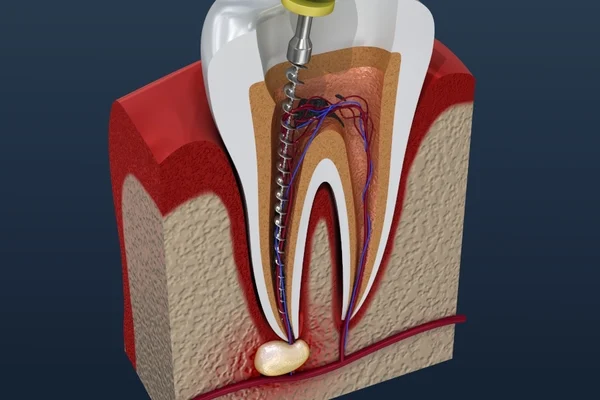
Root canal treatment is a tooth-saving method used when the soft vessel-nerve network (pulp) that gives the tooth vitality, lying under the enamel and dentine layers, becomes inflamed or damaged. It is the cleaning, disinfection and leak-proof filling of the infected tissues inside the canals that run from the crown of the tooth to the root tip, using special filling materials. In the past the only option for teeth with inflamed pulp was extraction; today, thanks to root canal treatment, natural teeth can be kept in the mouth and serve successfully for many years.
Who is it suitable for?
It is a necessary treatment for people whose deep, widespread decay has reached the pulp, or whose tooth has been knocked or broken. It is suitable for every patient who feels severe pain on chewing and pressure, who has extreme sensitivity to hot-cold stimuli, or who has toothache that does not pass with painkillers and starts on its own (especially at night).
How does treatment proceed?
Depending on the condition of the tooth and the extent of the infection, root canal treatment can be completed in a single session (30-60 minutes) or in several sessions. The process proceeds with these steps:
- Local anaesthesia: First the tooth and surrounding tissues are numbed so that the patient feels no pain during the procedure.
- Cavity preparation and access: Decay is fully cleaned and an access opening is made to reach the root canals.
- Working-length determination: The length of the root canal is determined in millimetres with radiography (X-ray) or special electronic devices.
- Shaping and disinfection: Inflamed pulp tissue is removed from the canal. The canals are shaped with various hand and rotary instruments and fully cleared of microorganisms.
- Filling: The cleaned and shaped canal spaces are filled with tissue-friendly materials that provide a seal, protecting the tooth against external factors.
Points to consider before treatment
- When toothache starts, medicines — especially antibiotics — must not be used without the dentist’s knowledge. These medicines only postpone the pain and make the inflammation more resistant, making treatment harder.
- Even if the pain eases temporarily, treatment must never be postponed. Neglected inflammation can turn into “abscess” pockets at the root tips and in the jawbone, causing bone destruction and ultimately loss of the tooth.
Points to consider after treatment
- Temporary sensitivity: Mild pain and chewing sensitivity may be seen in the tooth after treatment. This is entirely temporary. Anti-inflammatory medicines your dentist may recommend can be used.
- Chewing control: Until sensitivity settles, care should be taken not to use the side of the treated tooth for hard foods for a few days.
- Oral hygiene: The idea that “a root-treated tooth cannot decay” is wrong. Fractures can still occur in root-treated teeth, or gum problems may be experienced. Regular brushing, flossing and 6-monthly routine dental check-ups must therefore not be missed.
No. Before treatment begins, local anaesthesia is applied to the tooth and surrounding area. Thanks to the numbness obtained, you feel no pain during the procedure.
Pulp tissue has no ability to heal itself. Antibiotics taken without dental intervention only suppress the inflammation and postpone the pain for a while. Healing cannot be achieved until the inflamed tissue is physically removed from the canal.
There is no other tooth-saving method that can be an alternative to root canal treatment. If treatment cannot succeed, root-end surgery (resection) may be tried. If that is not possible either, the last resort is extraction of the tooth. Although the space after extraction can be restored with an implant or bridge, keeping the natural tooth is always healthier and more economical.
No, every tooth’s anatomy is different. Generally the incisors and canines in the front have 1 root and 1-2 canals. Premolars have 1-2 canals, while the molars at the back may have 3 or 4 canals. Extra canals can also be seen in some cases.