

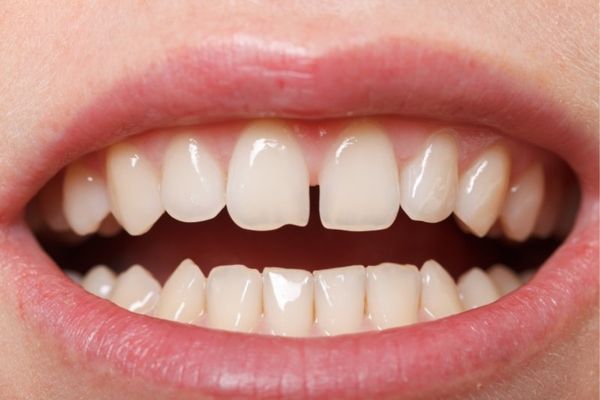
Diastema (gapped teeth)
What is diastema (gapped teeth) treatment?
Diastema is the presence of more space than there should be, or disproportionate spaces, between the teeth. This problem usually arises because the jaw is genetically too large or the teeth are smaller than normal. Injuries, accidents and tooth loss can also cause spaces (diastema) between the teeth. Diastema treatment is the whole of the restorative or orthodontic procedures applied not only to improve appearance but also to prevent speech problems caused by the tongue catching in the spaces and gum disease linked to bacterial plaque collecting between the teeth.
Who is it suitable for?
- Those with noticeable spaces between their teeth (especially between the two front teeth),
- Those whose tooth size is disproportionately small relative to the jaw,
- Those with speech problems (lisping, etc.) or pronunciation difficulty because of gapped teeth,
- Patients with bacteria, plaque formation and gum problems because food constantly collects in the spaces between the teeth.
How does treatment proceed?
The path in diastema treatment is first determined by the dentist assessing the distance between the teeth and the bite. According to the level of the opening, 3 different treatment methods are commonly applied:
- Composite veneer (bonding): A practical method applied when the space between the teeth is minimal or there is slight wear. The teeth forming the space are enlarged aesthetically by covering them with tooth-coloured composite. It is generally completed in a single session without reducing the tooth.
- Porcelain laminate (porcelain veneer): Preferred for mild and moderate spaces. The front surface of the teeth is slightly filed (roughened). Thin porcelain leaves (laminates) prepared in the laboratory to the person’s dental impression are bonded to the teeth with special agents. Compared with composite veneer it is much stronger, more lasting and more resistant to staining.
- Orthodontic treatment (braces / clear aligners): The healthiest and most natural method preferred when advanced spacing and a bite discrepancy are present together. Spaces are closed by moving the patient’s own natural teeth, without adding any restorative material. Treatment duration is longer than the other methods.
Points to consider before treatment
- Before gapped-tooth treatment begins, oral hygiene must be complete and any tartar and gum problems treated.
- The patient should communicate treatment expectations clearly to the dentist; the most appropriate method (orthodontics or laminate/bonding?) should be decided together with the dentist in the light of duration, budget and aesthetic expectations.
Points to consider after treatment
- If composite veneer (bonding) was done: Because these materials are a little more sensitive to fracture than the other methods, hard habits such as cracking hazelnuts or biting pens, and foods with shells, must be avoided completely.
- If porcelain laminate was done: Although durability is high, care should be taken with hard foods on the principle of protecting natural teeth.
- Oral care: Closing the spaces will prevent food collecting between the teeth, but regular brushing and especially interdental brushes/floss must not be neglected in order to prolong the life of the restorations.
- Retention (after orthodontics): If spaces were closed with orthodontic treatment, the protective aligners or fixed retainer wires given by the dentist must be used so that the teeth do not return to their former gapped position.
No. Besides creating an aesthetic concern, abnormal spaces between the teeth prepare the ground for food accumulation. This speeds bacteria and plaque formation and invites decay and gum disease. The tongue entering these spaces can also cause speech problems.
Yes. If the space (diastema) between your teeth is not very wide and there is no major problem in your bite, the spaces can be closed aesthetically in a single session in only a few hours with the composite veneer (bonding) method.
This depends on the amount of space and on your time. If there is no problem with the shape or colour of your teeth and there are only spaces, orthodontic treatment (braces/clear aligners) is the most ideal because it protects your own natural teeth. However, if you do not want to wait for the longer duration of orthodontic treatment, or if you also have colour/shape discrepancies in your teeth, porcelain laminate is the best alternative. Our specialist will offer you the most suitable option after examination.