

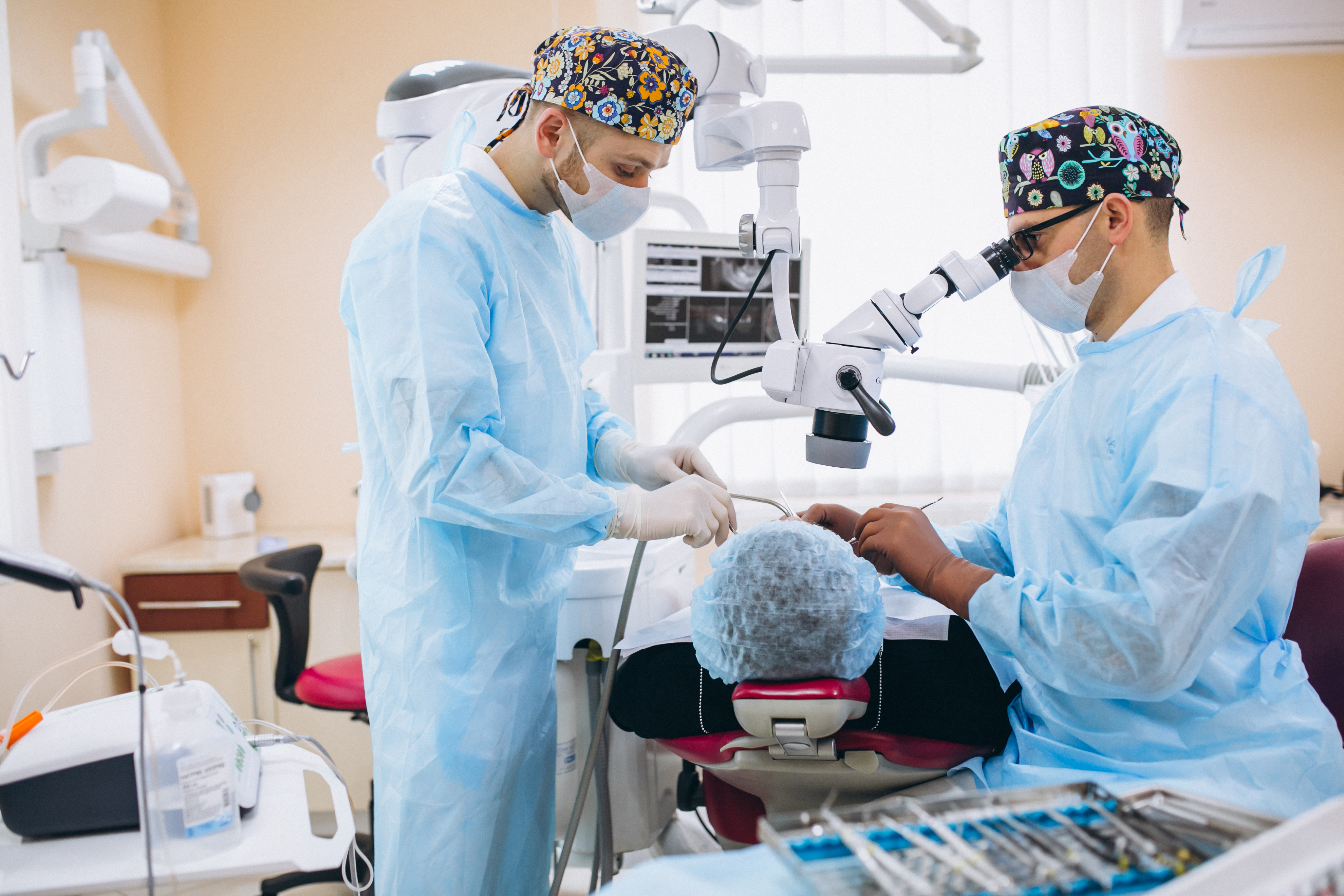
Surgical Procedures
What is the treatment?
Oral and maxillofacial surgery is the dental specialty that diagnoses and treats congenital or later-developing diseases of the soft and hard tissues of the mouth, jaw and face. This discipline covers the medical and surgical treatment of aesthetic, functional and speech (phonation) problems caused by infectious, traumatic or pathological reasons. This field, which requires advanced technology and expertise, offers solutions for all complex surgical needs of the mouth and jaw region.
Who is it suitable for?
Oral and maxillofacial surgery has a very wide scope and is suitable for all patients with the following problems:
- Those with impacted, partially impacted or erupted problem teeth (especially 20-year molars),
- Those who need dental implant treatment because of missing teeth,
- Those in whom cystic or tumoral formations or lesions are found in the jawbone or at root tips (those needing apical resection),
- Those with acute or chronic infection in the mouth, jaw and face,
- Patients with fractures in the jaw and face after accident or trauma,
- Those who need surgical arrangement of the oral tissues before a prosthesis (pre-prosthetic surgery),
- Those with maxillary sinus problems related to teeth and the jaw,
- Individuals with a jaw-bite discrepancy who need surgical correction of aesthetic/functional deformities (orthognathic surgery).
How does treatment proceed?
- Clinical and radiological examination: Intra-oral examination is carried out by our maxillofacial surgeon. Where necessary the operation site is examined in detail with 3D dental tomography (CBCT) or panoramic radiographs.
- Personalised planning: In the light of the data obtained, and taking the patient’s general health into account, the most suitable surgical plan is formed.
- Surgical procedure: The planned operation is carried out under local anaesthesia, sedation or general anaesthesia, according to the scale of the procedure and the patient’s anxiety, in fully sterile clinic or hospital conditions.
- Healing and follow-up: Medicines prescribed by the dentist after the operation are used. Follow-up sessions are arranged on set dates for suture removal and to check tissue healing.
Points to consider before treatment
- The patient’s general health, chronic diseases (blood pressure, diabetes, heart, etc.) and regularly used medicines (especially blood thinners) must be reported to the dentist in full.
- Oral hygiene should be observed before the operation; patients should come to the clinic after brushing their teeth.
- If the procedure will be under sedation or general anaesthesia, the fasting and fluid-restriction period specified by the dentist (generally 6-8 hours before the procedure) must be followed strictly.
Points to consider after treatment
- Bleeding and swelling control: The pack placed after the operation should be bitten firmly for the period specified by the dentist (generally 30-45 minutes). Intermittent ice packs should be applied from the outside for the first 24 hours to minimise possible oedema (swelling) and bruising.
- Diet: In the first days, very hot, very cold, hard and grainy foods should be avoided; lukewarm, soft foods (purée, soup, yoghurt, etc.) should be eaten.
- Habits: Smoking and alcohol should be avoided completely, especially for the first few days, because they affect healing directly and adversely. Movements that create a vacuum, such as spitting or using a straw, should not be done.
- Medication: Antibiotics, painkillers and mouthwashes prescribed by the dentist must be used in full at the stated times.
No. From impacted tooth extraction to implant operations or cyst treatments, all surgical procedures are carried out completely without pain and without sensation using appropriate anaesthesia methods (local anaesthesia, sedation or general anaesthesia).
In our clinic, impacted and complicated extractions, implant procedures, jaw cyst and tumour operations, root-end surgery (apical resection), treatment of jaw fractures, pre-prosthetic surgery, treatment of sinus pathology, treatment of intra-oral soft-tissue diseases, and orthognathic surgery to correct jaw-shape discrepancies are applied successfully by our specialists.
Not every impacted tooth has to be extracted. However, if the tooth causes pain, infection, decay in neighbouring teeth, cyst formation in the jawbone or orthodontic problems (crowding), it needs to be extracted surgically. Our specialist will make this decision clearly after examination.
This depends on the scale of the surgical intervention. After a simple impacted extraction or a single implant operation, patients can return to daily life the next day, whereas a few days of rest at home may be needed after more extensive cyst operations or jaw surgery.