

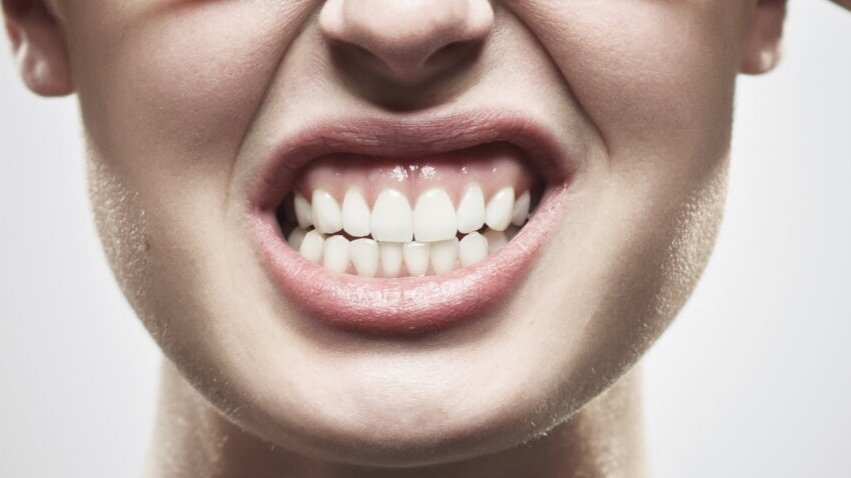
Teeth grinding – bruxism
What is bruxism treatment?
Bruxism is the problem of people clenching or grinding their teeth involuntarily, mostly at night during sleep or in the daytime while awake. This action causes the muscles that close the jaw to contract severely on both sides at the same time. Bruxism treatment is the whole of the multi-directional, protective approaches used to control these involuntary contractions, stop damage to the teeth, prevent jaw-joint injury and improve the patient’s quality of life.
Who is it suitable for?
It is suitable for individuals of any age who have the following symptoms or triggering factors:
- Those who feel severe pain in the jaw, temples and head region when they wake in the morning,
- Those with abnormal wear or zinging in the teeth or fractures in existing fillings/prostheses,
- Those with enlargement (hypertrophy) of the chewing muscles from overwork and jaw-joint complaints,
- Those with missing teeth, bite (occlusion) discrepancies, over-erupted teeth or faulty restorations,
- Those who grind their teeth because of anxiety, intense stress, sleep disorders or neurological conditions.
How does treatment proceed?
Depending on the cause of bruxism, the most suitable methods are applied by the specialist alone or in combination:
- Examination and diagnosis: The extent of wear on the teeth, muscle hypertrophy and existing bite discrepancies are identified by detailed examination.
- Protective splint applications: Custom clear “night guards” or “occlusal splints” to be used during sleep are prepared from the patient’s dental impressions. These appliances protect the teeth from rubbing against each other.
- Botox application: The excessive contraction strength of the muscles is weakened with botox injection into the chewing muscles.
- Dental and prosthetic corrections: Ideal jaw closure is obtained by replacing missing teeth, correcting faulty restorations and renewing ill-fitting prostheses.
- Supportive treatments: Under dental supervision, medication, stress therapy if the source is psychological, or surgical approaches in very advanced joint damage can be included in the process.
Points to consider before treatment
- Habits that can trigger clenching directly, such as heavy smoking and alcohol use, should be reviewed.
- If there are sleep disorders or neurological conditions, this must be explained to the dentist in detail.
- Awareness of stress and anxiety management should be developed and relaxation exercises included in daily life.
Points to consider after treatment
- The night guard or occlusal splints delivered by the dentist must be used regularly for the recommended period.
- Daily cleaning and storage of the appliances (night guard, etc.) must be observed with the greatest care.
- If botox was applied, the treated area should not be massaged for the first few hours after the procedure.
- Habits that extra-tire the jaw joint, such as chewing gum, eating hard foods or biting pens, must be avoided completely.
No. Although bruxism most commonly appears in night sleep, patients can also clench involuntarily in the daytime in situations of intense stress, concentration, anxiety or physical effort.
Botox applied to the chewing muscles seriously reduces the intensity of clenching by weakening the excessive contraction of the muscle concerned. It eases the head and jaw pain caused by clenching. Its effect is temporary (generally 4-6 months) and it can be repeated if needed.
Yes. A high filling that disrupts the bite (occlusion) of the teeth, missing teeth or faulty restorations are among the important anatomical causes that disrupt the balance of the jaw joint and trigger bruxism directly.
Untreated bruxism leads to permanent wear on the chewing surfaces of the teeth, hot-cold sensitivity, and fractures in the teeth and porcelain restorations. In later stages it can cause severe headaches, enlargement of the jaw muscles and permanent damage in the jaw joint (TMJ).