

Prosthetic Applications
What are dental prostheses?
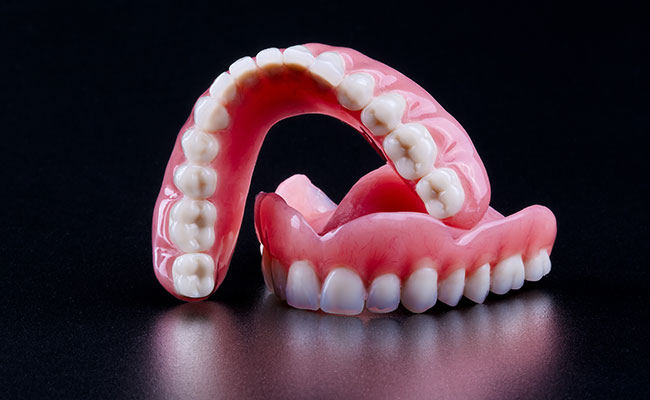
Dental prostheses are artificial tooth applications made to restore lost teeth, a disrupted mouth structure and chewing functions, and at the same time to restore facial aesthetics and speech comfort. The main aim of prosthetic treatment is to return both aesthetics and chewing comfort to the patient while protecting the health of the tissues inside the mouth. In our clinic the following types of prosthesis are applied according to the number of missing teeth and the tissue condition:
- Complete denture (full / plate denture): Removable prostheses made with support from the jawbone and tissues when there are no teeth left in the mouth.
- Clasp denture (classic partial denture): Removable prostheses that attach to remaining healthy teeth with wires called clasps in partial tooth loss.
- Precision-attachment denture (press-stud denture): Aesthetic, comfortable removable prostheses in partial tooth loss that eliminate the aesthetic inconvenience of a visible clasp and obtain retention from special housings (press-studs) hidden inside the teeth.
Who is it suitable for?
- Those with impaired chewing function and collapse/change in facial aesthetics,
- Patients who have lost one, several or all of their teeth,
- Individuals whose jawbone is not suitable for implant treatment or who prefer not to have surgery,
- Those who wish to obtain aesthetic and functional chewing strength with the support of their remaining teeth.
How does treatment proceed?
- Determining the prosthesis type at examination: Intra-oral tissues, remaining healthy teeth and the jawbone are examined in detail. The prosthesis option best suited to the patient’s aesthetic and functional expectations (complete, clasp or precision-attachment) is decided.
- Impression and design: Precise impressions of the mouth are taken and sent to the laboratory for a custom prosthesis design.
- Try-ins: Several try-in sessions are carried out to check the fit of the prosthesis with the jawbone and teeth, its appearance, tooth colour and bite/occlusion balance.
- Delivery and adaptation: The finished prosthesis is fitted for the patient. Use of the prosthesis, insertion and removal techniques and care rules are explained in detail.
Points to consider before treatment
- Before the prosthesis impression is taken, existing decay in the mouth must have been treated, scaling carried out, and loose or infected teeth that need extraction removed.
- The health of the supporting healthy teeth for precision-attachment or clasp dentures must be assessed by the dentist; if needed, those teeth should be crowned.
Points to consider after treatment
- Adaptation period: Slight changes in speech or a feeling of foreignness in the mouth in the first days while getting used to new prostheses is normal. You can speed this process by wearing the prostheses regularly as your dentist recommends.
- Oral and prosthesis hygiene: Removable prostheses should be taken out after every meal and cleaned under running water with special denture brushes or soft brushes. Prostheses should be removed at night so that the tissues can rest.
- Sore spots and wound check: It is natural for the prosthesis to cause slight sore spots or wounds on the gum in the first days of use. In that case the prosthesis must not be filed by the patient; small adjustments (reductions) should be made by seeing the dentist.
- Diet: Soft foods should be preferred in the first days until you get used to the prosthesis, and chewing should use both sides of the jaw equally.
In clasp dentures retention is provided by metal clasps wrapped around the outer surfaces of remaining teeth, and these clasps may be visible when smiling. In precision-attachment dentures the retainer is hidden inside the teeth or under the crown; no metal is visible from outside and the look is extremely natural aesthetically.
No, it is recommended that prostheses be removed when sleeping at night. This allows the gum tissues and bone under the prosthesis to rest and minimises the risk of fungal infection. Removed prostheses should be kept in special denture boxes or in water after cleaning.
Loosening or slackness of prostheses may occur over time because of natural resorption in the jawbone and gums. In such cases, instead of replacing the prosthesis completely, a “reline” (rebasing) by your dentist can make your prosthesis sit fully on your jaw again.