










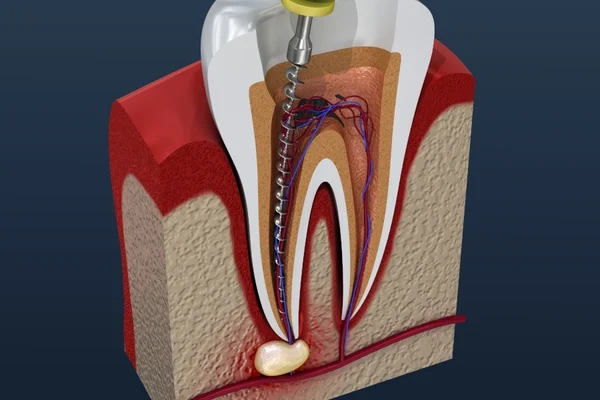
What is Root-Canal Treatments?
Root canal treatment is a method of preserving a tooth that is carried out when the soft network of blood vessels and nerves (the pulp) located beneath the tooth’s enamel and dentine layers—which gives the tooth its vitality—becomes inflamed or damaged. It involves cleaning and disinfecting the infected tissue within the canals—which extend from the crown of the tooth to the root tip—and sealing them with specialised filling materials to ensure they are completely leak-proof. Whereas in the past, tooth extraction was the only option for teeth with inflamed pulp, today, thanks to root canal treatment, natural teeth can be preserved in the mouth and continue to function successfully for many years.
Who is it suitable for?
This treatment is essential for patients with deep and extensive cavities that have reached the pulp tissue, or whose teeth have been knocked or fractured. It is suitable for any patient who experiences severe pain whilst chewing or under pressure, who has extreme sensitivity to hot and cold stimuli, or who suffers from toothache that does not respond to painkillers and occurs spontaneously (particularly at night).
How Does the Treatment Process Work?
Root canal treatment can be completed in a single session (30–60 minutes) or over several sessions, depending on the condition of the tooth and the extent of the infection. The process proceeds as follows:
-
Local Anaesthesia: First, the tooth and surrounding tissues are numbed to ensure that the patient feels no pain during the procedure.
-
Cavity Preparation and Access: The tooth decay is completely removed and an access cavity is created to reach the root canals.
-
Root Canal Length Measurement: The length of the root canal is measured to the nearest millimetre using radiography (X-rays) or specialised electronic devices.
-
Shaping and Disinfection: Infected pulp tissue is removed from the root canal. The root canals are shaped using various hand and rotary instruments and are thoroughly disinfected to remove all microorganisms.
-
Filling: The cleaned and shaped root canal spaces are filled with biocompatible materials that ensure a tight seal, thereby protecting the tooth from external factors.
Points to Bear in Mind Before Treatment
-
When a toothache begins, medicines – particularly antibiotics – should not be taken without consulting a dentist. These medicines merely delay the pain and make the infection more resistant, thereby complicating treatment.
-
Even if the pain subsides temporarily, treatment should never be postponed. If left untreated, the infection can develop into pockets of pus – known as ‘abscesses’ – at the root tips and in the jawbone, leading to bone destruction and, ultimately, tooth loss.
Post-Treatment Precautions
-
Temporary Sensitivity: You may experience mild toothache and sensitivity when chewing following treatment. This is entirely temporary. You may take anti-inflammatory medication as recommended by your dentist.
-
Biting Precautions: For a few days, until the sensitivity has subsided, you should take care not to use the side of the mouth where the treated tooth is located to chew hard foods.
-
Oral Hygiene: The belief that ‘teeth that have had root canal treatment do not decay’ is incorrect. Teeth that have undergone root canal treatment can still fracture or develop gum problems. For this reason, regular brushing, flossing and routine six-monthly check-ups with the dentist should not be neglected.
1. Will I feel any pain during root canal treatment?
No. Before treatment begins, a local anaesthetic is administered to the affected tooth and the surrounding area. Thanks to the numbness this causes, you will not feel any pain during the procedure.
2. Will my tooth get better if I just take antibiotics?
Pulp tissue does not have the ability to heal itself. Antibiotics taken without dental treatment merely suppress the inflammation and temporarily relieve the pain. Healing cannot take place unless the inflamed tissue is physically removed from the root canal.
3. Are there any alternatives to root canal treatment?
There is no other method of preserving a tooth that could serve as an alternative to root canal treatment. If the treatment is unsuccessful, apical surgery (resection) may be attempted. If this is not possible either, the last resort is to extract the tooth. Although the gap left after extraction can be filled with an implant or a bridge, preserving the natural tooth is always healthier and more cost-effective.
4. Do all teeth have the same number of root canals?
No, the anatomy of each tooth is different. Generally, the incisors and canines in the front have one root and one or two canals. The premolars have one or two canals, whilst the molars at the back may have three or four canals. In some cases, extra canals may also be present.