










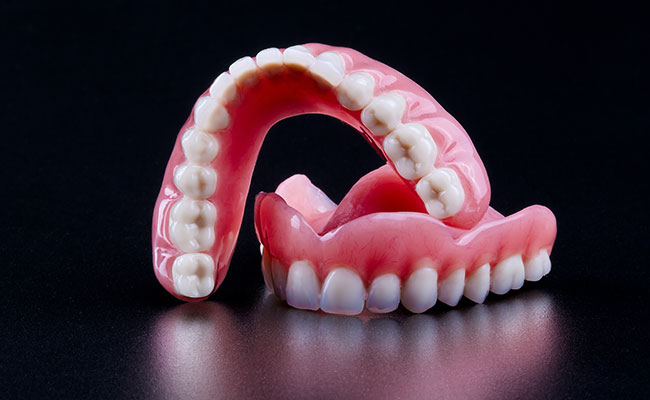
What are dental prostheses?
Dental prostheses are artificial teeth applied to replace lost teeth, restore damaged oral structure and chewing functions, as well as restore facial aesthetics and speech comfort. The main goal of prosthetic treatment is to restore both aesthetics and chewing comfort to the patient while preserving the health of the oral tissues. In our clinic, the following types of prostheses are applied depending on the number of missing teeth and the condition of the tissues:
-
Complete Dentures (Total Dentures): These are removable dentures made using support from the jawbone and tissues in cases where there are no teeth in the mouth.
-
Clasp Dentures (Classic Partial Dentures): These are removable dentures used for partial tooth loss, attached to existing healthy teeth with wires called clasps (hooks).
-
Precision Attachment Dentures (Snap-on Dentures): These are aesthetic and comfortable removable dentures that eliminate the aesthetic discomfort of hook-like appearances in cases of partial tooth loss, and derive their retention from special sockets (snaps) hidden within the teeth.
Who is it suitable for?
-
Those experiencing impaired chewing function and sagging/changes in facial aesthetics,
-
Patients who have lost one, several, or all of their teeth,
-
Individuals whose jawbone structure is unsuitable for implant treatment or who prefer not to undergo surgery,
-
It is suitable for those who want to achieve aesthetically pleasing and functional chewing power with the support of their existing teeth.
How does the treatment process progress?
-
Determining the Type of Prosthesis During Examination: The oral tissues, remaining healthy teeth, and jawbone are examined in detail. The most suitable prosthesis option (Full, Clasp, or Precision Attachment) is determined based on the patient’s aesthetic and functional expectations.
-
Measurement and Design: Precise measurements of the inside of the mouth are taken and sent to the laboratory for custom prosthesis design.
-
Trials: Several trial sessions are conducted to check the prosthesis’s fit with the jawbone and teeth, its aesthetic appearance, tooth color, and bite/occlusion balance.
-
Delivery and Fit: The completed prosthesis is fitted to the patient. The patient is given detailed explanations of how to use the prosthesis, the techniques for insertion and removal, and the care instructions.
Things to Consider Before Treatment
-
Before taking impressions for a prosthesis, any existing cavities in the mouth must be treated, tartar removed, and any loose or infected teeth that need extraction must be removed.
-
In precision-attached or clasp dentures, the health of the healthy teeth that will provide support should be evaluated by the dentist, and if necessary, these teeth should be crowned.
Things to Consider After Treatment
-
Adjustment Process: It’s normal to experience slight changes in speech or a feeling of strangeness in the mouth during the first few days of adjusting to new dentures. You can speed up this process by wearing the dentures regularly as recommended by your dentist.
-
Oral and Denture Hygiene: Removable dentures should be removed after each meal and cleaned under running water with special denture brushes or soft brushes. Dentures should be removed before going to bed at night to allow the tissues to rest.
-
Soreness and Wound Control: It is normal for the prosthesis to cause slight sores or wounds on the gums during the first few days of use. In this case, the prosthesis should absolutely not be filed down by the patient; minor adjustments (grinding) should be made by a dentist.
-
Nutrition: In the first few days, until you get used to the prosthesis, soft foods should be preferred, and chewing should be done using both sides of the jaw equally.
1. What is the difference between hook-on dentures and precision attachment (snap-on) dentures?
In clasp dentures, retention is provided by metal clasps that wrap around the outer surface of the existing teeth, and these clasps may be visible when smiling. In precision attachment dentures, however, the retention mechanism is hidden inside the teeth or under the veneer; no metal is visible from the outside, resulting in a completely natural aesthetic.
2. Can I sleep with my dentures on at night?
No, it is recommended to remove dentures before going to bed at night. This allows the gum tissue and bone under the dentures to rest, minimizing the risk of fungal infections. After removal, dentures should be cleaned and stored in special denture cases or in water.
3. Will my dentures loosen or fall out of my mouth over time?
Over time, natural bone and gum resorption can cause dentures to loosen or become baggy. In such cases, instead of completely replacing the denture, your dentist can perform a “refitting” procedure to make it fit your jaw perfectly again.